2026
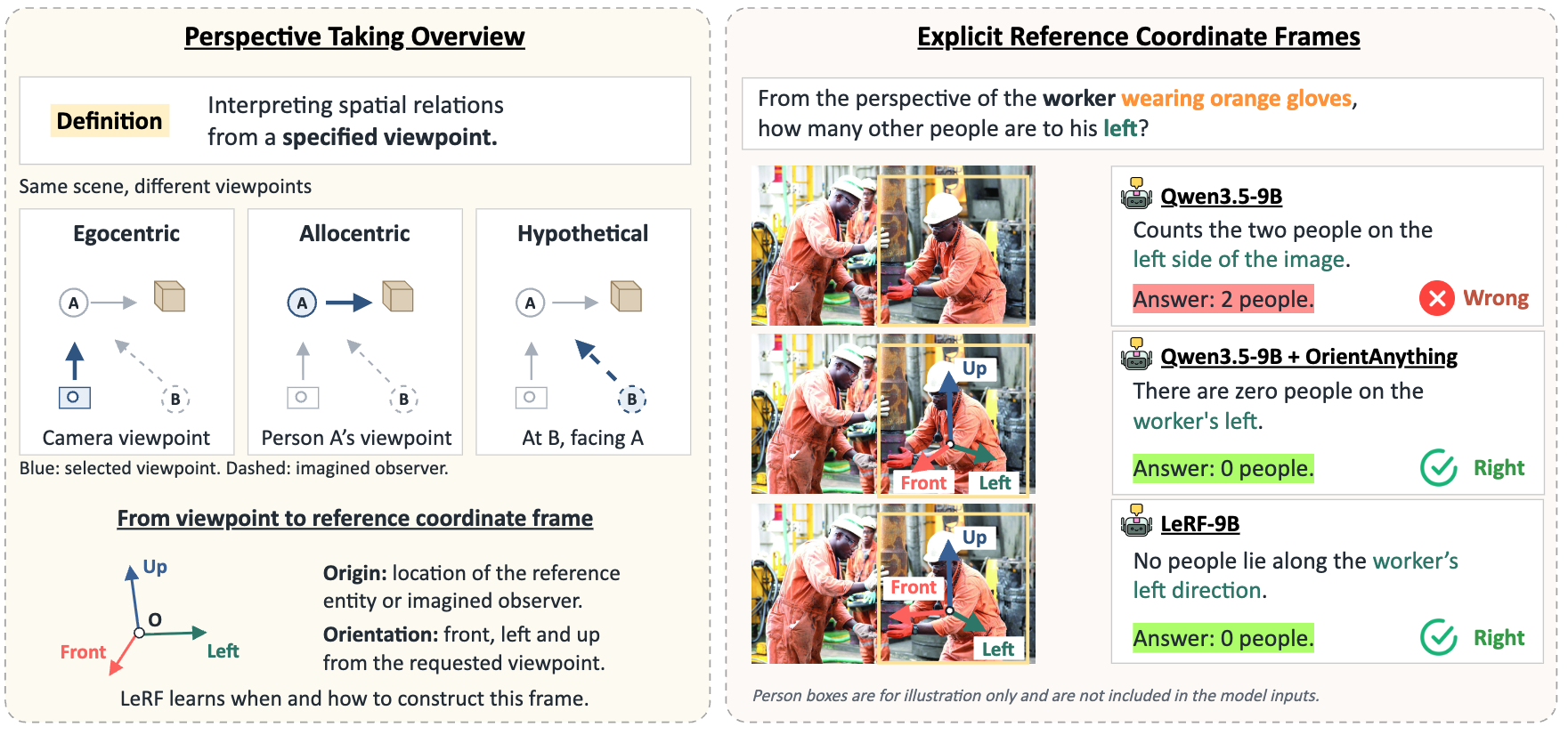
LeRF: Learning Reference Coordinate Frames for Perspective Taking Reasoning
Bang Xiao, Wenqi Jia, Ozgur Kara, Tiancheng Shen, Yibo Yang, Bolin Lai#, Junho Kim#, James Matthew Rehg# (# corresponding author)
arXiv preprint 2026
Perspective taking requires spatial reasoning from viewpoints beyond the camera, yet current VLMs often struggle to make this shift. We introduce LeRF, which trains VLMs to selectively construct and render explicit entity-centered reference frames and use these visual cues for viewpoint-dependent reasoning, through supervised fine-tuning followed by reinforcement learning. LeRF consistently improves over its backbone across diverse perspective-taking benchmarks and also yields better reference-frame grounding and orientation estimation.
LeRF: Learning Reference Coordinate Frames for Perspective Taking Reasoning
Bang Xiao, Wenqi Jia, Ozgur Kara, Tiancheng Shen, Yibo Yang, Bolin Lai#, Junho Kim#, James Matthew Rehg# (# corresponding author)
arXiv preprint 2026
Perspective taking requires spatial reasoning from viewpoints beyond the camera, yet current VLMs often struggle to make this shift. We introduce LeRF, which trains VLMs to selectively construct and render explicit entity-centered reference frames and use these visual cues for viewpoint-dependent reasoning, through supervised fine-tuning followed by reinforcement learning. LeRF consistently improves over its backbone across diverse perspective-taking benchmarks and also yields better reference-frame grounding and orientation estimation.
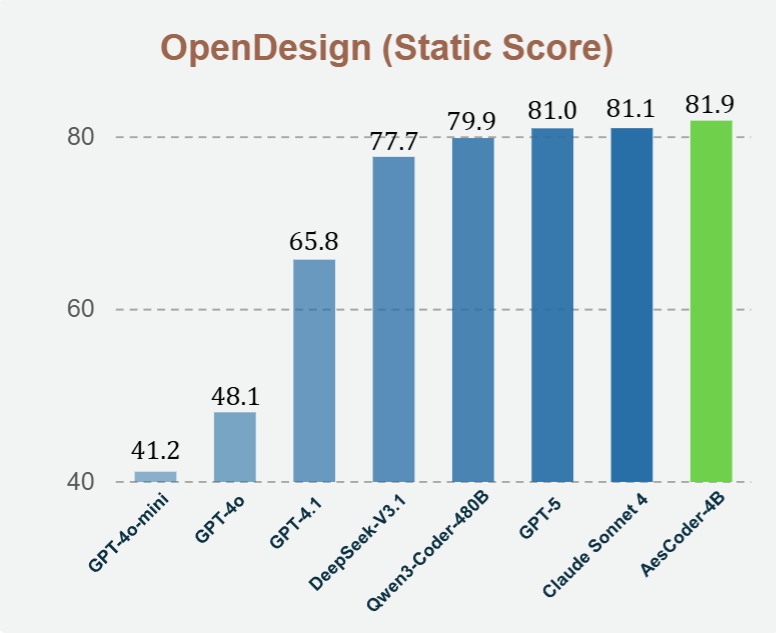
Code Aesthetics with Agentic Reward Feedback
Bang Xiao*, Lingjie Jiang*, Shaohan Huang#, Tengchao Lv, Yupan Huang, Xun Wu, Lei Cui, Furu Wei (* equal contribution, # corresponding author)
International Conference on Learning Representations (ICLR) 2026
We present a unified framework for aesthetic code generation that substantially improves both visual quality and functionality. With a large-scale dataset, agentic reward feedback, and a new benchmark, our 4B model outperforms GPT-4o and GPT-4.1 and matches the performance of open-source models hundreds of times larger. This work establishes a strong and scalable approach to advancing code aesthetics in large language models.
Code Aesthetics with Agentic Reward Feedback
Bang Xiao*, Lingjie Jiang*, Shaohan Huang#, Tengchao Lv, Yupan Huang, Xun Wu, Lei Cui, Furu Wei (* equal contribution, # corresponding author)
International Conference on Learning Representations (ICLR) 2026
We present a unified framework for aesthetic code generation that substantially improves both visual quality and functionality. With a large-scale dataset, agentic reward feedback, and a new benchmark, our 4B model outperforms GPT-4o and GPT-4.1 and matches the performance of open-source models hundreds of times larger. This work establishes a strong and scalable approach to advancing code aesthetics in large language models.
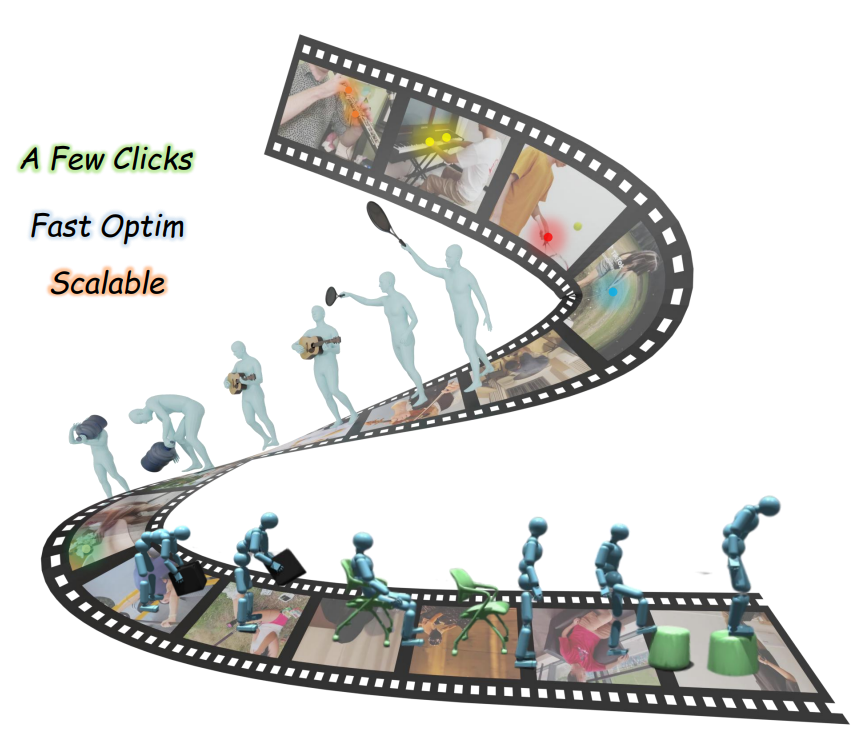
Efficient and Scalable Monocular Human-Object Interaction Motion Reconstruction
Boran Wen*, Ye Lu*, Keyan Wan, Sirui Wang, Jiahong Zhou, Junxuan Liang, Xinpeng Liu, Bang Xiao, Dingbang Huang, Ruiyang Liu, Yonglu Li# (* equal contribution, # corresponding author)
arXiv preprint 2026
We introduce 4DHOISolver, a human-in-the-loop framework that enables scalable and physically plausible 4D human–object interaction reconstruction from monocular internet videos. Using this approach, we build Open4DHOI, a large-scale dataset with 144 object types and 103 actions, and show that the recovered interactions can drive RL-based imitation learning. Our results also reveal that accurate contact prediction remains a key open challenge for current 3D foundation models.
Efficient and Scalable Monocular Human-Object Interaction Motion Reconstruction
Boran Wen*, Ye Lu*, Keyan Wan, Sirui Wang, Jiahong Zhou, Junxuan Liang, Xinpeng Liu, Bang Xiao, Dingbang Huang, Ruiyang Liu, Yonglu Li# (* equal contribution, # corresponding author)
arXiv preprint 2026
We introduce 4DHOISolver, a human-in-the-loop framework that enables scalable and physically plausible 4D human–object interaction reconstruction from monocular internet videos. Using this approach, we build Open4DHOI, a large-scale dataset with 144 object types and 103 actions, and show that the recovered interactions can drive RL-based imitation learning. Our results also reveal that accurate contact prediction remains a key open challenge for current 3D foundation models.
2024
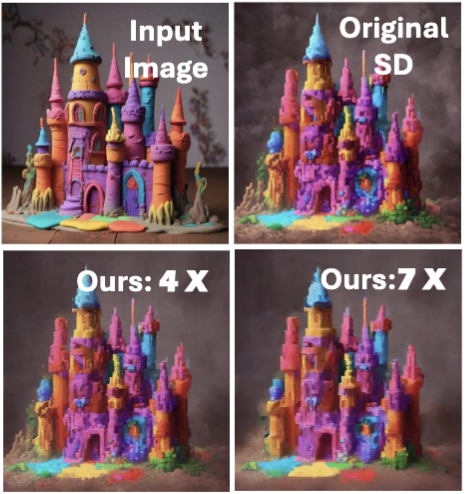
Token Pruning for Caching Better: 9$\times$ Acceleration on Stable Diffusion for Free
Evelyn Zhang*, Bang Xiao*, Jiayi Tang, Qianli Ma, Chang Zou, Xuefei Ning, Xuming Hu, Linfeng Zhang# (* equal contribution, # corresponding author)
arXiv preprint 2024
Based on token prune and layer cache technology, we present a new Stable Diffusion acceleration method named dynamics-aware token pruning (DaTo). In the COCO-30k, we observed a 7$\times$ acceleration coupled with a notable FID reduction of 2.17.
Token Pruning for Caching Better: 9$\times$ Acceleration on Stable Diffusion for Free
Evelyn Zhang*, Bang Xiao*, Jiayi Tang, Qianli Ma, Chang Zou, Xuefei Ning, Xuming Hu, Linfeng Zhang# (* equal contribution, # corresponding author)
arXiv preprint 2024
Based on token prune and layer cache technology, we present a new Stable Diffusion acceleration method named dynamics-aware token pruning (DaTo). In the COCO-30k, we observed a 7$\times$ acceleration coupled with a notable FID reduction of 2.17.